
Crawl Space Condensation: Mold Risks for Missouri Homes
Missouri's humid climate turns crawl spaces into mold breeding grounds. Learn how spray foam insulation stops condensation and protects your home's structure.
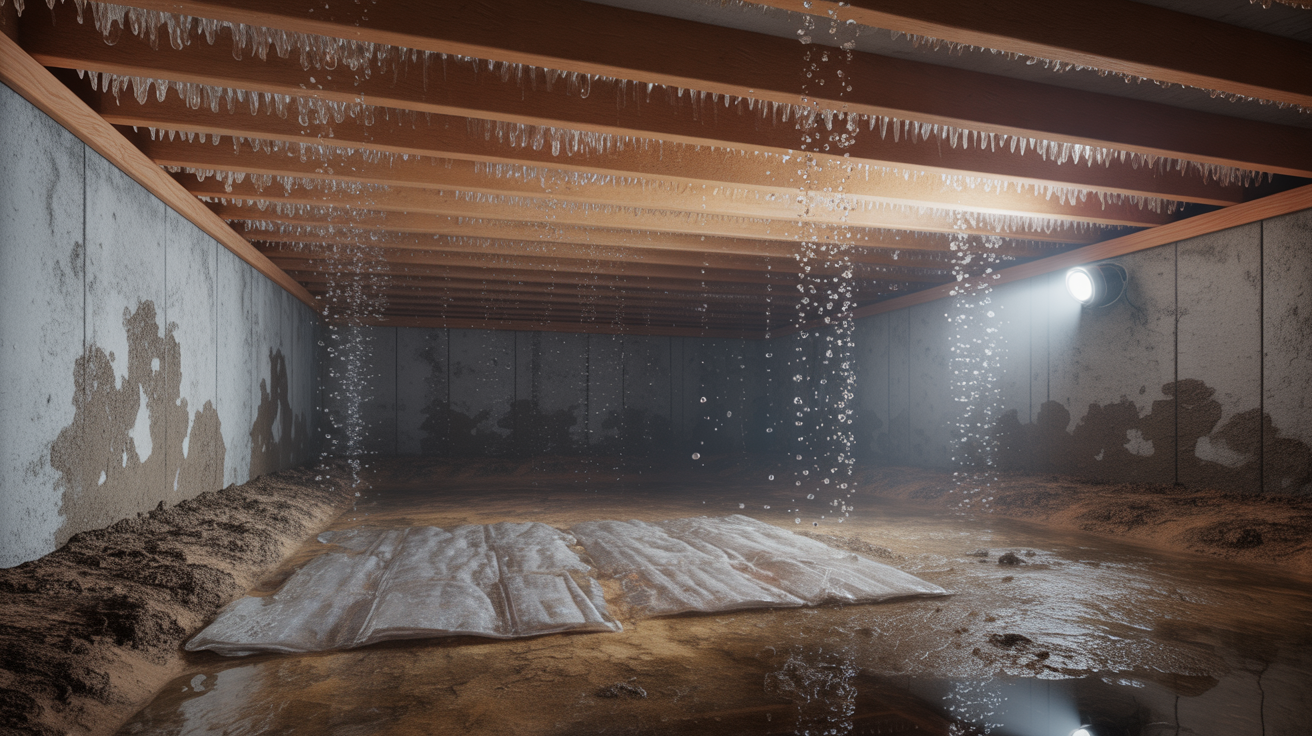
Why Crawl Spaces Are Ground Zero for Moisture Problems in Missouri
If you own a home in Springfield, Nixa, Ozark, Republic, or Marshfield, there's a good chance your crawl space is working against you — even if you've never noticed a problem. Southwest Missouri sits in a climate zone where warm, humid air from the Gulf of Mexico collides with cooler continental air masses throughout spring and summer. That combination creates ideal conditions for condensation to form in the one part of your home that almost nobody thinks about: the crawl space.
Condensation happens when warm, moisture-laden air contacts a cooler surface. In a vented crawl space — which describes the majority of older homes in the Ozarks region — outdoor air flows freely through foundation vents. During Missouri's humid months, that incoming air is often 70 to 80 percent relative humidity or higher. When it meets the cooler wood framing, floor joists, and subfloor above, the moisture drops out of the air and settles on every surface it touches. Over time, this creates the exact conditions that mold and wood rot need to thrive.
The Science Behind Crawl Space Condensation
Understanding why condensation forms requires a basic grasp of dew point — the temperature at which air can no longer hold its moisture and begins releasing it as liquid water. In a Missouri summer, outdoor air at 85°F and 75% relative humidity has a dew point around 76°F. If the surfaces in your crawl space are even slightly cooler than that — which they often are, since the ground stays cooler than the air above — condensation forms immediately and continuously.
This isn't a seasonal quirk. It's a physics problem that repeats itself every time warm, humid air enters a cooler enclosed space. Vented crawl spaces were originally designed under the assumption that ventilation would dry out any moisture that accumulated. Building science research over the past few decades has largely disproven that assumption, particularly in humid climates like Missouri's. In many cases, ventilation actively introduces more moisture than it removes.
What Mold Needs — and Why Crawl Spaces Provide It
Mold requires four things to grow: moisture, a food source, oxygen, and a temperature range between roughly 40°F and 100°F. A vented crawl space in Southwest Missouri checks every box. The wood framing and subfloor provide an abundant food source. Oxygen is plentiful. Temperatures stay within the mold-friendly range for most of the year. And condensation supplies a steady stream of moisture.
The most common mold species found in crawl spaces — including Cladosporium, Penicillium, and Aspergillus — can begin colonizing wood surfaces within 24 to 48 hours of sustained moisture exposure. Once established, mold degrades the structural integrity of floor joists and subfloor sheathing over time. It also produces spores that migrate upward through gaps in the floor assembly into the living space above, affecting indoor air quality throughout the home. If you've ever noticed a musty smell in your home that you couldn't trace to a specific source, the crawl space is often the culprit. This is closely related to how spray foam insulation improves indoor air quality for Missouri families.
Why Traditional Crawl Space Approaches Fall Short
Many homeowners attempt to address crawl space moisture with fiberglass batt insulation installed between the floor joists, sometimes combined with a thin plastic vapor barrier laid on the ground. While this approach is inexpensive, it has significant limitations in Missouri's climate.
Fiberglass batts are permeable to moisture vapor. They don't stop humid air from reaching the wood surfaces above them — they simply slow it down slightly. When batts absorb moisture, they lose their insulating effectiveness and can actually hold moisture against the wood framing, accelerating the conditions that lead to rot and mold. A thin polyethylene vapor barrier on the ground helps reduce ground moisture evaporation, but it does nothing to address the humid air entering through foundation vents.
The result is a system that provides a false sense of security. Homeowners believe the crawl space is protected, but the underlying moisture dynamics remain unchanged. This is one of the top insulation problems in Greene and Christian County homes that building professionals encounter regularly.
How Spray Foam Changes the Equation
Closed-cell spray foam insulation applied to the crawl space walls and rim joists — rather than between the floor joists — fundamentally changes how the crawl space interacts with moisture. Instead of trying to manage humid air after it enters, spray foam prevents it from entering in the first place.
When the foundation walls and rim joists are sealed with closed-cell spray foam, the crawl space becomes what building scientists call a "conditioned" or "semi-conditioned" space. Foundation vents are sealed or eliminated. The crawl space is no longer exposed to outdoor air. Instead, it shares the thermal and moisture characteristics of the home's interior. Temperatures stabilize. Relative humidity drops. The dew point conditions that cause condensation simply don't occur.
Closed-cell spray foam is particularly well-suited to this application because of its low vapor permeability. It acts as both an insulator and a vapor retarder, blocking moisture-laden air from diffusing through the wall assembly. Its rigid, adhesive structure also seals around pipes, beams, and irregular surfaces where gaps commonly allow air infiltration. For a deeper look at how the two types of spray foam compare for different applications, open-cell vs. closed-cell spray foam for Missouri homes covers the key differences in detail.
The Long-Term Structural and Financial Case
The consequences of unaddressed crawl space moisture extend well beyond mold. Wood rot in floor joists and subfloor sheathing is a structural issue that can cost tens of thousands of dollars to remediate. Pest infestations — particularly termites and carpenter ants — are more likely in damp wood environments. HVAC systems that serve homes with poorly conditioned crawl spaces work harder to maintain comfortable temperatures, driving up energy costs year after year.
Spray foam insulation in the crawl space addresses all of these risks simultaneously. By stabilizing the thermal environment, it reduces the load on your heating and cooling system. By eliminating condensation, it removes the conditions that support mold and wood-destroying insects. And by sealing air infiltration pathways, it prevents the stack effect that draws crawl space air — and whatever contaminants it carries — into the living space above. These compounding benefits are part of what makes spray foam a long-term investment, not a temporary fix.
What Missouri Homeowners Should Look For
If your home has a vented crawl space and you haven't had it inspected recently, there are several warning signs worth investigating. A persistent musty odor in the home, especially on the ground floor, often indicates mold activity below. Soft or springy spots in the floor can signal subfloor deterioration from moisture damage. Elevated humidity readings in the living space — particularly during Missouri's spring and summer months — may point to moisture migrating upward from the crawl space.
A professional inspection can identify whether condensation is actively occurring, whether mold is present, and what the current condition of the wood framing looks like. In many cases, homeowners are surprised to find significant moisture damage in a crawl space they assumed was fine. Catching these issues early, before structural damage becomes extensive, is far less costly than remediation after the fact.
Practical Steps for Southwest Missouri Homeowners
If you're considering addressing your crawl space, the most effective approach combines several elements: sealing foundation vents, applying closed-cell spray foam to the crawl space walls and rim joists, installing a heavy-duty vapor barrier on the ground (typically 20-mil polyethylene), and ensuring the space has some connection to the home's conditioned air — either through a small supply duct or a dehumidifier.
This encapsulation approach is now widely recognized as the building-science best practice for humid climates, and it's particularly well-suited to the conditions that Southwest Missouri homeowners face. The investment pays dividends in reduced energy costs, improved indoor air quality, and the peace of mind that comes from knowing your home's structural foundation is protected. Understanding why moisture problems often start in hidden structural areas can help you prioritize where to focus your attention first.
The crawl space may be out of sight, but in Missouri's climate, it should never be out of mind. Addressing condensation and moisture control at the foundation level is one of the most impactful improvements a homeowner can make — not just for comfort, but for the long-term health and value of the entire home.